
“Could you do some of the stereotypical school subjects each type might be likely to have interest in?”
ENTJ: business, law
INTJ: chemistry, physics
ENTP: computer science
INTP: philosophy, maths Continue reading
“Could you do some of the stereotypical school subjects each type might be likely to have interest in?”
ENTJ: business, law
INTJ: chemistry, physics
ENTP: computer science
INTP: philosophy, maths Continue reading
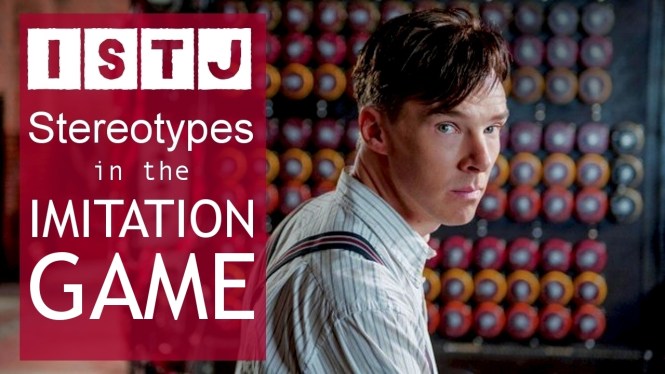
ISTJs are frequently stereotyped as whining, OCD, rule-obsessed intellectuals with no social skills. Either that, or they’re portrayed as evil, emotionless cyborgs with no sense of humour. As someone with a close ISTJ friend, I understand exactly how terrible those stereotypes can be on a person. Unfortunately, such stereotypes are ever present in the media, and have found their way needlessly into the recent film, The Imitation Game. Continue reading

Surely, you’ve looked at the personality description for your Meyers-Briggs type at one point and thought, “that’s not me. I don’t do those things.”
Well, guess what? You’re not alone. I can’t tell you how many times I look at the INTJ stereotypes and think to myself, “How can anyone assume that you must be exactly the same as all other people who share your type?” Continue reading
“Hi, I’ve taken the test a lot and I always get typed ESTJ, but I don’t feel like an extravert because I don’t always want to be with people. At the same time, everyone I’ve asked tells me I communicate like a total extravert. Could I be a mix between ISTJ and ESTJ?”

Not likely. My advice to you would be to learn more about the functions and determine your type based on that rather than any of the MBTI tests. The tests can be rather inaccurate because a lot of the questions are interpretively ambiguous.
Remember Mycroft? Whom I retyped from ISTJ to ESTJ a while back? (based on the functions). He’s what you might call and antisocial extravert. His cognitive functions work in the order of an ESTJ, but he doesn’t necessarily need to be around people to get Continue reading
Question: “I suffer from depression (ENFP) and was wondering about how that translates to functions. I understand if you don’t know much about depression and can’t answer the question, but I just wondered.”
Answer: No matter your MBTI type, depression is always a highly emotional experience, so that ought to clear up the myth that T-types can’t be depressed.
Function-wise, depression tends to lock people into their introverted functions (this applies more to clinical depression than acute depression). As an ENFP, you’re likely going to lock yourself into your Fi and Si functions. Depending on the intensity of your depression, as well a your ability to control it (here, the word control is subjective), you may also end up suppressing your extroverted functions entirely. Continue reading
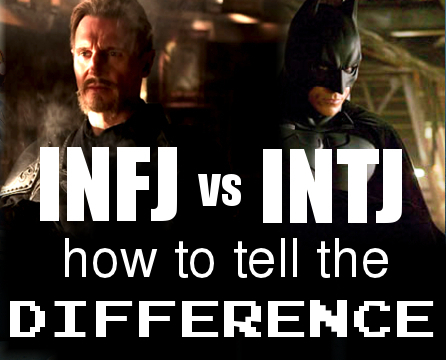
Loads of people get it into their heads that the sole difference between INTJs and INFJs is that the latter are sweet and kind while the former are complete apathetic jerks. Unfortunately, this assumption is based on stereotypes and doesn’t include the jungian functions at all.
In my experience, there are plenty of both types that defy the stereotype beyond reason, to the point that MBTI-Typers who go based on stereotypes are bound to get them wrong.
This type of behaviour can also be observed if you watch Sherlock.
INxJs share two common functions: dominant Ni, and inferior Se. As a result, it’s easy for the Continue reading

Contrary to popular belief, introverts need people just as much as extraverts do –just in different ways. Introverts don’t necessarily get their energy from being around people the way that extraverts do, but we still need people for emotional/psychological reasons.
At some point in life, everyone wants to know they’re not alone –even if they don’t want to admit it. When you’re isolated for too long, you can’t help feeling that isolation –either that or you just start to feel empty inside. Continue reading

Subscribe to get access to the rest of this post and other subscriber-only content.
“Ok so I sometimes try to type characters but I always think the smart ones have to be Ts instead of Fs. Could you give examples of what each type would look like as geniuses? Also, are some types more likely to be clever than others?”

First of all, personality type doesn’t necessarily have anything to do with intelligence. It has to do with how the brain functions, not how well it functions. That said, I do think that the way the brain functions does play into what a person’s interests they are (for instance, how interested they are in learning). So yes, I would say that certain types are more likely, although not universally set to be more intellectual.
NTs typically show up in statistics as having the highest IQs. I was tested at one point with an IQ of 146, but in my opinion, IQ isn’t really an accurate measure of intelligence, and here’s why.
The definition of intelligence is highly subjective. One might be intelligent in the area of mathematics, or one might also be incredibly intelligent as to the art of baking. But, since I’ve assumed that you’re talking about the vile patriarchal values that dictate my education (aka book-smarts), I’ve comprised a list of examples for you.
However, do keep in mind that MBTI personality types have loads of stereotypes hooked on them. For instance, the stereotype that all INTxs are geniuses.
Wrong. Remember, there are people like Billy Pilgrim.
Furthermore, the media has an overwhelming tendency to present each personality type according to stereotypes. Most of the uber-intelligent characters that come up in fiction tend to be rationals. There far fewer NTs that pop up in fiction presented as stupid, and very few SFs that are presented as smart. Ultimately, that leads to further stereotyping of all NTs as smart and all SFs as stupid. Poor children of this earth…
Consider also, that there are varying degrees of intelligence. In one place, a person may be the smartest person in the room, but step into the next room and they may feel like a blundering idiot in pannyhoes.
Here are some examples, and like I said –yes, there seem to be more of them in certain categories than others. I’ve included both fictionals and real people. Obviously, not all of these are going to be geniuses, but I’ve tried to put in what a fairly intelligent person should look like for each type.
INTP: Charles Augustus Magnussen, Peter Parker, Charles Darwin, Rene Descartes
ENTP: the 11th Doctor, the 5th Doctor, Jim Moriarty, Petra Arkanian, Leonardo da Vinci, Thomas Edison
INTJ: Ender Wiggin, the 12th Doctor, the 4th Doctor, Sherlock, Stephen Hawking, Nikola Tesla, Steve Jobs, John Nash
ENTJ: Peter Wiggin, Tony Stark, Bill Gates, Carl Sagen, Loki (Thor)
INFP: the 9th Doctor, Albert Einstein, Brian Cox, Tom Hiddleston, John Green
ENFP: Jonathan Strange, the 10th Doctor, Michio Kaku
INFJ: the 8th Doctor, Neils Bohr, Bruce Banner (the Hulk – sometimes INTP depending on the actor playing him)
ENFJ: Charles Xavier, Gwen Stacy
ISTP: Indiana Jones, Natasha Romanov (Black Widow)
ESTP: Tintin
ISTJ: Mr. Norrell, Spock, Sigmund Frued, Allan Turing
ESTJ: Hermione Granger, Mycroft Holmes, Bryan Mills (Taken)
ISFP: Jane (Ender’s Game)
ESFP: Benedict Cumberbatch…is unfortunately the smartest one I can think of…
ISFJ: Rory Gilmore (Gilmore Girls)
ESFJ: Danielle de Barbarac (Ever After)
Sorry, but I couldn’t think of any for the blank ones. Comments gladly welcome if you think of any.
It appears that NTs are in the lead (actually, to be completely honest, I deliberately cut the INTx lists down to just to be nice to the ENTx groups). NFs and STs appear next in line and sorry for all of you SFs, but you’re last. Results are inconclusive. Judge as you see fit.
“You mention stereotypes a lot in your posts. Could you tell what you think are the main stereotypes of each MBTI type?”
Obviously, the stereotypes don’t accurately describe each type. Some of the types have mainly positive stereotypes, while others get negative stereotypes.
Here goes.
boring, shallow and traditional, doormat, clingy, demanding, motherly, gentle

extremely shallow slut, obsessed with image, insincere, stupid

obsessive compulsive disorder, cop where no cop has been appointed, robots with no feelings, un-creative

control freak who judges everyone, workaholic, incredibly biassed, strict, don’t know how to have fun, obsessed with keeping the rules, teacher’s pet

sociopaths, secretly plotting to overtake the world, most likely to kill you in your sleep, geniuses, arrogant, always the villain, robots with no feelings, incapable of being in a relationship

entrepreneur manipulator, bully, power hungry, narcissistic, have no ethical code, bossy, doesn’t care about you

empath who loves everyone, are ethically perfect, have a psychic understanding of everyone,

gullible sweetheart, cuddle bunny, naive and innocent, smiley and overemotional
ultra-creative emo, loners, non-confrontational, emotionally unstable, day-dreamer

super smiley happy person with dreams, ADHD, constant mood swings, childish, concerned with social image

philosopher that can’t make decisions, gamer, geniuses, atheists, computer wizards, robots with no feelings

ADHD lunatic, can’t take anything seriously, gets their kicks from seeing people’s reactions, no feelings

James Bond, criminally insane, into extreme sports, likes cars, risk taker

I’m going to jump off that cliff and see what happens, hyper-sexual, doesn’t think before acting

incredible artist, animal lover, over-sensitive, disorganised and terrible at planning, pushover

easily entertained goof-off, party animal, hypersexual, attention whore, flow, dumb, thinks they’re INTJs

*I spelled Humour the American way in the title because the majority of my readers are American.*
Have you ever noticed how people who like Hitchiker’s Guide to the Galaxy are more likely to enjoy Doctor Who, Sherlock, Neil Gaiman and Terry Pratchett? This is intuitive humour at its finest.
(Psst! If you liked any of the former fandoms, you should read Jonathan Strange & Mr. Norrell!)
Intuitive MBTI types tend to enjoy wordplay related sarcasm, deadpan and hyperbole, especially NT types. The differences between Extraverted Intuitive (Ne) and Introverted Intuitive (Ni) humour are subtle, but I’m going to attempt to dispel those differences. Continue reading

It’s not uncommon that people of different MBTI types consider the others selfish. Extraverted Feelers (Fe-users) often see Introverted Feelers (Fi-users) as selfish, and vice versa.
Fe-users look at Fi-users and seeing them more in tune with themselves than others, perceive this as selfishness. Fi-users look at the Fe tendency to go with the crowd and perceive them as fakes. Continue reading
Subscribe to get access to the rest of this post and other subscriber-only content.
Become a paid subscriber to get access to the rest of this post and other exclusive content.
Become a paid subscriber to get access to the rest of this post and other exclusive content.
 The Book Addict's Guide to MBTI: