INTJs! Don’t Hide from your Feelings!

Sumayyah asked: As an INTJ. I used to be very detached and anything emotional aggravated me. However, my problem lately has been that I’m usually in a bad mood or temper. I snap at people more often. I don’t like to hear or have any conversations that make emotions and feelings the center. Also, I have been betrayed by the man that I liked. I don’t know how to deal with these sudden feeling and emotions. It seems very illogical to me and aggravates me that they are controlling me. Do you have any advice or tips for an INTJ do deal with this situation.

Here’s my #1 piece of advice: DO NOT TURN OFF YOUR UPPER FUNCTIONS. Do everything you can to avoid locking into only your lower functions (this is called being “in the grip” and it isn’t a healthy state to be in). Make use of your upper functions.

My second piece of advice is to avoid locking into a loop between your Extraverted Thinking (Te) function and your Extraverted Sensing (Se) function. Often, INTJs experiencing emotional trauma will do this in order to detach from the strong feelings they’re enduring. Just as I warn you not to lock into only your lower functions, it’s unwise to stop using any function simply to avoid dealing with a problem.

To quote one of my all-time favourite Christopher Nolan films, “you always fear what you don’t understand.” And it sounds like there’s a disjunct between your emotions and your understanding of them (thus your fear of them).

Take your TeFi and analyse your feelings. Allow yourself to feel those feelings, but then ask yourself why you’re feeling what you’re feeling. Mature INTJs do not hide from their feelings. They face them without allowing the feelings to control them.

It is perfectly possible to feel strongly and still be rational. The feelings themselves may be irrational, but the only way you’re going to talk yourself out of that irrationality is to analyse those feelings so that you can understand them, and to do that, you have to feel them.

You will never understand anything that you spend all your time hiding from.

ENFPs and Trauma

Meredith asked: “I have a friend who’s was a total ENFP but then he went through a traumatic experience and now he doesn’t seem like an ENFP at all. Could he have changed to an introverted type?”

Probably not, although, yes, if the trauma you’re referring to was physical head trauma, a stroke or anything that could cause brain damage and literal personality changes. However, I’m going to assume that you’re talking about something that was psychologically traumatizing.

First of all, everyone (hopefully) undergoes Continue reading

Valentine Wiggin: INFJ

Ender’s Game Saga, Orson Scott Card

Valentine Wiggin INFJ | Ender's Game MBTI

Ni: Valentine has little difficulty keeping Demosthenes a secret for over 3000 years. She’s an incredibly focused person, and tends to be a bit of a workaholic. As a working mom, she regrets not spending more time with her children, Continue reading

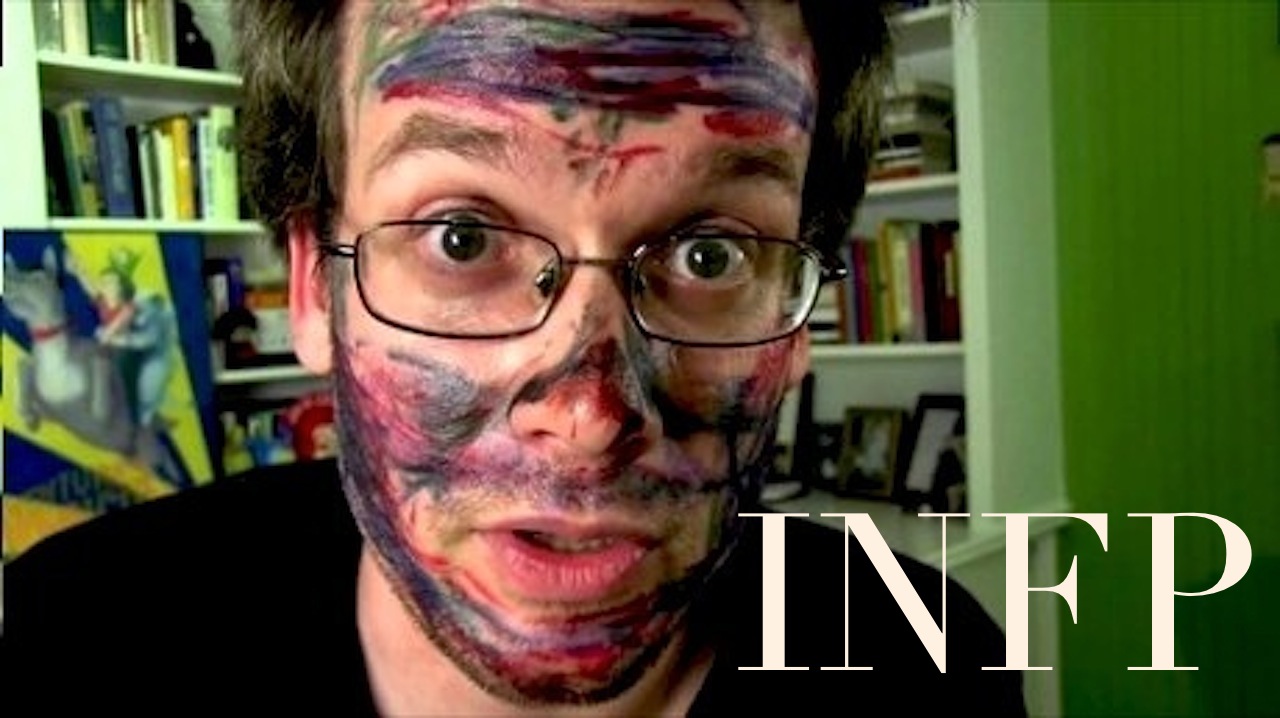
John Green: INFP

John Green INFP

Introverted Feeling (Fi): John Green usually doesn’t make his feelings public (though his ideas are very public). He’s good at writing deep, highly emotional characters who ask harsh questions about morality and the nature of human existence. His writing is always highly emotion driven and leaves most F-type readers sobbing when they The Fault in Our Stars, or Looking for Alaska. John Green has a strong desire to help other people and certainly does so through his writing and vlogging. Continue reading

INTJs: Embarrassed about Crying in Public?

Abbie asked: Help! I’m an INTJ and I’m crying… In a public place… With no secluded spot or sanctuary I can run to… And people are watching… What do I do? What do you do?

Answer: Curtesy queue interruption –this is what you should do.

Forget that other people are watching.

It does not matter what anyone thinks of you. A person who judges you for crying is not someone whose opinion you should value enough to let it affect you. When you cry in public, that’s when you really discover the character of the people you care about. The ones who judge you aren’t people you want to keep around and those who don’t will probably be your friends for life.

Secondly, you should never be ashamed of crying.

There are large quantities of immature T-types out there who will tell you that emotion is for weaklings. To that, I say that if you have not cried –if you have not been broken, your life has been too easy and you have not learned enough.

Don’t listen to anyone who tells you that you’re weak for emoting. Crying releases endorphins, which is why we sometimes can’t feel better until we’ve had a decent cry. Emotion is what makes us human. If we could not feel, we would not make moral decisions.

If there is nowhere to hide your tears, stop worrying about it and deal with what’s really important (aka the issue that’s making you cry in the first place).

When an issue is important enough, just let yourself cry. Who cares if people are watching? Cry, and then move on. That’s all I can really tell you.

Novinha – Ender’s Game: ISTJ

Ender’s Game Saga, Orson Scott Card

Other factors to keep in mind: PTSD

Si: She’s capable of holding long-term, committed grudges. She has an extremely difficult time letting go of pretty much everything from her past. Yeah, her parents died when she was a kid, but she never, ever, ever lets go of that. In fact, she lets it turn her into an icy, cold, and even hateful person (yet, she doesn’t show signs of PTSD). Her first impressions of Ender, she directly relates to Libo and her past experience. Though Novinha is an idealist, her practicality is her strongest trait. She’s practical enough to give up some of her strongest desires to protect people.

Te: In comparison to Novinha, Ender seems like an F dom, but in reality, they’re both Te users. From a young age, Novinha is filled with ambition that leads her to want to take control of Lusitania’s zenobiology department before she’s ready. She likes to be in control of her situation and lashes out at others when she feels she’s Continue reading

Using MBTI to Communicate Effectively

Using MBTI to Communicate Effectively

Question: Hi! I’m an INFP female with some sort of Aspie-autistic spectrum disorder thing (I don’t know the word) and I was wondering, is it crazy that I think that just by looking and interacting with a person long enough, no matter how long I’ve known them or what, that I can detect what their personality type is, and then from that, use this poss-umption (possibility/assumption/don’t judge me) in order to formulate how I will react and respond to their self-ness? I don’t know… I feel like you would be able to culminate the right amount of truth from this curiosity, and how weirdly I needed to word it in order to explain how I felt myself was trying to be explained. Wow that was a train wreck. Anyways, thanks!

INTJ translation: After enough exposure to MBTI, is it possible to learn how to type people in conversation and then change your behaviour/language to accommodate their thought process?

Answer: Yes. I do it every day.

The key to a good friendship is always to give the impression that you not only like the other person, but that you understand them. This isn’t always easy or possible, but using your understanding of MBTI, you can definitely get better at it. Continue reading

Dr. Allison Cameron: ESFJ

House MD

Dr. Allison Cameron: ESFJ | House MD MBTI

Fe: Early on, Cameron is easily compromised by her emotions. She attaches herself emotionally to people, and this often ends up interfering with her work. When she’s mad at someone (or she loves someone), her objectivity us compromised. Cameron has a hard time understanding why other people’s (Fi people’s) sense of morality is different than hers. She expects that there is a universal standard of morality that applies these same Continue reading

To my Grammar Nazis

Recently, I’ve gotten an influx of grammar-correcting comments, which I’d like to address. I believe grammar is expressly important, but it’s not the most important thing in writing.

You spelled ______ wrong! Don’t you understand how important grammar is?

Being a grammar nazi is a poor way to assert your intelligence because it merely expresses emotional immaturity. A grammar nazi is a person who lacks the self-control necessary to restrain themselves from voicing their inner-critic at inappropriate times and places. He misses the big picture in order to focus on minute details.

Correcting other people’s grammar does not make anyone think of you as a genius. A person may be academically intelligent, but that does them no good if they lack emotional maturity. On a larger scale, this is why Ender Wiggin was chosen to fight the bugger war over his brother Peter. Both were incredibly intelligent, but one of them lacked emotional maturity.

I completely understand the urge to correct other people’s grammar –believe me. However, self-control is far more important. If you can’t control the things you chose to say, then who are you? Because you’re not your own person. You’re simply being swayed one way and another by your emotional responses to things that aren’t important.

“Recognise is spelled with a Z.”

Yeah, maybe in America, but in the UK, we spell it with an S. My earlier attempts to cater all my spellings toward Americans (who comprise the largest percentage of my readership) were a flop, and I’ve gone back to UK spellings.

Consider this. Which is more important? Somebody else’s correctness, or your maturity? Are you simply going to react to everything you see, rather than assertively making a decision as to how you will respond? Are you going to sacrifice your own maturity for the sake of something you probably can’t change?

I am an English Major. I knew the risks of deciding not to spend an extra ten minutes editing per post on this website. It’s for this very reason that I specifically avoid connecting this blog to the books/stories that I’ve published.

I apologise for any grammatical errors you may find on this blog. I’m sorry if they offend you, but they don’t offend me enough that I’m going to spend my entire day off trying to fix all of them.

Clara Oswald: ENTP

Doctor Who

Clara Oswald ENTP | Doctor Who #MBTI #ENTP

Ne: Clara has no problem seeing potentials and ideals. She views the world and the people in it in terms of ideals, what could potentially become rather than what is right in front of her. She makes connections between less obvious dots and catches on to unvoiced connections between people. Clara is a big picture person who believes the future Continue reading

Ianto Jones: ISFJ

Torchwood

Ianto Jones ISFJ | Torchwood #MBTI #ISFJ

Dominant Introverted Sensing (Si): Ianto has an eye for the archaic, be it pocket watches, 1920s films or Jack’s coat. He also tends to rely on old fashioned methods for doing things, such as timing events with a pocket watch rather than a computer. He’s terrified by the thought that when he dies, Jack might eventually forget him. Ianto is able to memorise information on the spot and is able to recall it off the cuff when nobody Continue reading

Aragorn: ISTP

Lord of the Rings, JRR Tolkien

Aragorn ISTP INFJ | Lord of the Rings MBTI

Ti: Aragorn doesn’t talk much about his thoughts, and when he does, he’s always careful to think through his thoughts before he speaks. He has an objective view of the world and is capable of making tough decisions where a others aren’t. At times, he Continue reading