Susan Pevensie: ISTJ

Guest post by E.J., INTJ

The Chronicles of Narnia, C.S. Lewis

Peter Pevensie ISTJ | The Chronicles of Narnia #MBTI #ISTJ

Dominant Si: Susan generally tries to rely on past experience to solve the problems that she and her siblings face. When the Pevensies are sent away from London to the Professor’s house, Susan tries to do what their mother would have done in taking care of her siblings. She reminds Edmund to go to bed, breaks up arguments, and ensures that her siblings wear coats when they leave the wardrobe for the snowy Narnian world. Susan cares about meeting social expectations and being polite. When she realizes that Mr. Beaver wants to be complimented on his dam, she promptly does so. Susan’s concern about being socially acceptable means that she does not accompany the Narnian armies during her reign. Corin describes her as being “more like an ordinary grown-up lady” than her INFP sister, Lucy, who regularly rides to the wars alongside their brothers. Ultimately, Susan’s concerns about meeting social expectations override her memories of Narnia. She ends up caring more about society perceiving her as an attractive, well-adjusted young woman than she does about living in this world with a Narnian perspective, since she knows that she cannot physically return to Narnia. As a result, she is not party to her siblings’ plan to save Narnia, and she does not arrive in the new Narnia with them. (Whether their deaths make her relive her memories of Narnia and bring about a change in her attitude is a question that the books do not answer.) Continue reading

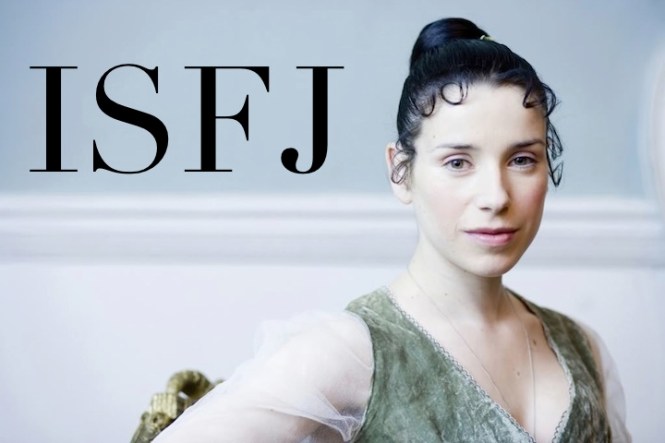
Anne Elliot: ISFJ

Guest post by E.J., INTJ

Persuasion, Jane Austen

Anne Elliot ISFJ | Persuation #MBTI #ISFJ

Dominant Si: The past is very important to Anne. Her close friendship with Lady Russell partially stems from Lady Russell’s connection to Anne’s mother, and Anne often goes to Lady Russell for advice. Anne also continues to love Wentworth nearly a decade after she broke off their engagement. While others do not always notice Anne’s intelligence, she is very perceptive and has a good memory for detail. Continue reading

Rubeus Hagrid: ISFP

Guest post by Andrew, ENTJ

Harry Potter, J. K. Rowling

Rubius Hagrid ISFP | Harry Potter #MBTI #ISFP

Introverted Feeling (Fi): Hagrid takes a liking to everyone he meets, unless they give him some reason to be unlikeable.  He is immediately accepting of Ron and Hermione when Harry brings them over for tea, but he can’t stand Draco Malfoy, who is notorious as a bully and a bigot.  His compassion even extends to dangerous monsters (his pets have included dragons, giant man-eating spiders, and vicious three-headed dogs), and he often labors under the delusion that even the most bloodthirsty creatures in existence are, in fact, harmless.  Hagrid has an unshakable loyalty to Albus Dumbledore, and will physically attack anyone who dares to insult him, but that doesn’t stop him from criticizing Dumbledore to his face when he believes the Hogwarts headmaster is making a mistake.  Hagrid is very emotional, but he doesn’t like to show his feelings to anyone else; when he is found to be a descendant of giants, he retreats to his cabin for several weeks, brooding on his shame and embarrassment alone.  Hagrid takes it personally when Harry, Ron, and Hermione discontinue taking Care of Magical Creatures in their sixth year, and the three of them have to convince him that they are not actually snubbing him. Continue reading

Ragnar Lothbrok: ENTJ

Guest post by Fanta, INTJ

Vikings (2013)

Ragnar Lothbrok ENTJ | Vikings 2013 #MBTI #ENTJ

Dominant Te: Ragnar Lothbrok is a serious and focused leader who is quick to retort and act to gain the upper hand when things do not go his way. He is a pioneer in his own right, and fully organised a raid to England (using improved technologies) even before getting approval from Earl Haraldson, whose denial of his wish to raid the west promptly caused Ragnar to question his authority. His peers quickly rally under his command, and whoever questions his plans, such as his brother Rollo, gets a firm retort that closes the door to discussion. Even during celebrations, Ragnar never relaxes, instead observing the people he does not trust, and planning his next move to deal with those who may be a threat to his Ni vision. Continue reading

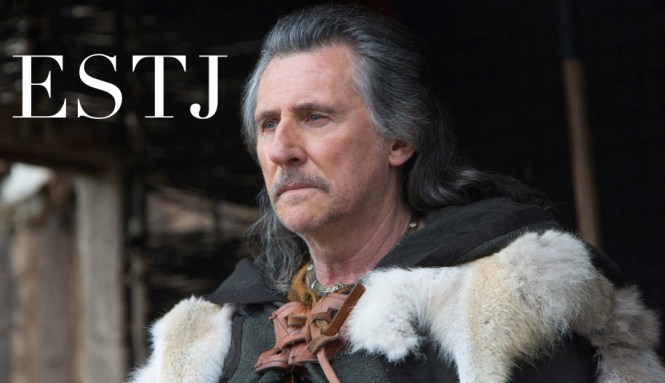
Earl Haraldson: ESTJ

Guest post by Fanta, INTJ

Vikings (2013)

Earl Haraldson ESTJ | Vikings 2013 #MBTI #ESTJ

Dominant Te: Earl Haraldson’s motivation is the establishment and respect of his authority. He is chiefly concerned about his power and social status in Kattegat, and will take action swiftly to keep the order and ascertain his dominance. When Ragnar challenges him publicly about exploring the West, he immediately perceives his ambitious behaviour as a threat to himself and stubbornly refuses to go with this plan, a fact he later confesses to his wife. He sends spies, attempts to salvage his authority by Continue reading

Anakin Skywalker: ESFP

Guest post by Andrew, ENTJ

Star Wars

Anakin Skywalker ESFP | Star Wars #MBTI #ESFP

Extroverted Sensing (Se): Anakin shows a knack for piloting from a very young age.  Whether he’s at the controls of a podracer, a starfighter, an airspeeder, or a heavily damaged enemy battle cruiser, Anakin can dodge obstacles and dart through firefights, and fire the kill shot to boot.  He has an excellent aim whenever flying an armed vessel; he saves Obi-Wan’s life by blasting diminutive circuit-wrecking droids off his fighter in the middle of an attack run.  Anakin tends to charge into fights without thinking, and once even abandons an assigned post to rescue his captured mother.  He also has a strong taste for aesthetics, almost letting Obi-Wan die fighting a bounty hunter while he chooses just the right speeder to give chase.  Anakin notices small things about his environment which tend to make a great deal of difference; he notices a speeder of which he’d lost the trail re-emerge many feet below him, as well as Qui-Gon’s lightsaber when the Jedi Master is in disguise.  Anakin reacts quickly and effectively to sudden changes; when his podracer catches fire in the middle of a race, he stays cool, salvaging both the vehicle and the victory. Continue reading

So I just saw all of your comments…

Don’t think I’m ignoring them. I swear I will reply to them all after I finish finals.

Also. I just looked at my inbox…which is bursting with a million and six questions and character requests.

As a temporary measure intended to save the life of Arvid Walton, I will be shutting down the Ask an INTJ Anything and Request a Character sections on this blog. Fear not. I shall reinstate them once I get caught up on the many hundreds of questions and requests that beset me there.

In the meantime, I would highly appreciate anyone who wants to help with the character typing queue, and I’d like to further thank all those who have contributed up to this point.

In the next week or so, I intend to announce the winners of the last contest along with the answers to the questions posed about me.

Simultaneously, I will confront the horrors of my inbox. Or possibly I shall run away and write poetry.

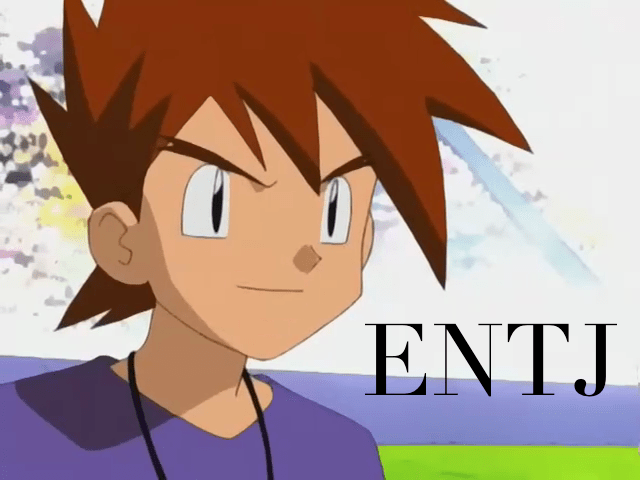
Gary Oak: ENTJ

Guest post by Andrew, ENTJ

Pokémon Anime Franchise

Gary Oak ENTJ |Pokemon #MBTI #ENTJ

Extroverted Thinking (Te): Gary is results-oriented to the core.  In the time it takes Ash to catch around forty Pokemon, Gary catches over 200.  He wins ten badges for the Indigo Pokemon League, even though only eight are required for entry.  Rather than giving all his Pokemon equal training time, he concentrates on the ones that have given him the best results.  Gary does not travel alone early on; instead he travels in a car, delegating the responsibility of transportation (and maybe other responsibilities as well) to others.  Gary always manages to be one step ahead of his peers while journeying; Ash, while traveling through Kanto and Johto, sees or hears how far ahead of him Gary would be whenever he thinks he’s doing well.  He always has the relevant information ready for every task he attempts.  As a young boy, Gary is responsible enough to be entrusted with tasks beyond the capacity of most adults, such as holding guard at Lake Valor to protect the legendary Pokemon Azelf. Continue reading

Organisation Styles Based on MBTI Type

Kerissa asked: I’ve noticed that you organise your posts one within the other, like stacking boxes. For example, when you hover on ‘Idiot’s guide to MBTI’ there’s ‘Typing Guide’ as an option. Click on that and there’s a list of articles. Click on the first of those and it’s ‘First, Get to Know the Crucial Concepts.’ From there it goes to another list. Some of those links go to a post, others go to a collection of posts. This boxes within boxes approach is a lot how I organize my Google Drive, folders within folders, and I was wondering if it had to do with the functions. It seems like a behavioral thing that actually would relate to functions without being a stereotype.

Somebody is paying attention to the way I organise!

Usually people with a Te function tend to have a specific mode of organisation that they follow (this is not usually true of Ti, especially upper Ti).

Intuitive (Ni & Ne) people are more likely to organise starting with the general, and then working to the specific.

Sensors (and here, I’m talking about Si) are going to organise from the specific to the general.

For instance, my ESTJ mother will organise everything according to specific type (Si) and function (Te). In her sewing room, she has a box for fabric, a box for thread, and a box for elastic, a box for stuffing etc.

Specific combinations of functions are also going to give you different results as well.

As an INTJ, I organise from the general idea of a thing (Ni) and move next to its function (Te).

For instance, I have a large toolbox in which I store my art supplies. Inside the toolbox, you would find a large quantity of smaller cigar boxes in which I’ve stored art supplies and tools according to what they’re used for.

In terms of blog and document storage, I do the same thing. I look at the content of my documents and then arrange them into folders, then subfolders and so on. For this reason, one of my favourite writing programs to use is Scrivener, because it allows me to organise everything of the same topic in one place. I use it for writing novels, poetry, and even taking notes in class.

My ESFP sibling organises based on appearance only (Se). If there is nothing on the floor, their bedroom qualifies as “clean.” Just so long as they can’t see the mess, it’s “organised.”

My ENFP sibling is great at keeping things organised once they’re organised (for the most part – their Te is tertiary), but their Ne sees so many possibilities that they doesn’t always know where to start. I helped them move into their new apartment this fall, and I did most of the organising for them.

All these years, they assumed that because I have so many boxes inside of boxes and folders inside of folders etc. that my stuff was merely cluttered. It had never occurred to them that it was organised, only that it looked chaotic because the method behind it was so structured.

My INTP dad cannot organise at all. At all. He looks at clutter and has absolutely no idea where to start. Part of this is a lack of Te function (Te is a natural organisation function, and part of it is his Ne getting distracted before he can start.

Louis Zamperini: INFP

Unbroken

Louis Zamperini Unbroken ENFP

Fi: As a teenager, Zamperini isolated himself from his classmates and put up a tough front to hide the misery he felt inside. Running gave him a way to deal with his feelings and helped him to develop principles that came to define the rest of his legacy. He was always a bit rebellious and liked to define his own morality, rather than relying on Continue reading