Doran Martell: INTJ

Guest Post by Arthur, ENTP

A Song of Ice and Fire, George R.R. Martin

Dominant Introverted Intuition (Ni): Doran’s political career is largely characterized by two components: precaution and long-term planning. Those two characteristics are key to understanding his political actions. His Ni is especially easy to spot if you look at his goal of restoring the Targaryen dynasty to the Iron Throne. He plots over decades and contacts various magisters in Essos, as well as Willem Darry, then protector of Viserys and Daenerys, with whom he made a deal to marry Arianne when Viserys is ready to claim the rulership. So over decades, his political goals remained unchanged, them being revenge on the Lannisters and restoring Viserys III, and later Daenerys to the throne.

Continue reading

Tyler Joseph: INFP

Guest Post by Andrea, INFJ

Dominant Introverted Feeling (Fi): Tyler appears to be aware and practising his personal values, often stemming from his Christian faith which teaches kindness to the disadvantaged. This value is illustrated when he momentarily stops showing to help those in need. As an example, he asked security to help out an audience member having a panic attack during a performance. He is unafraid to challenge the mainstream music scene in preference for his own unique style of musical composition. Tyler is also mindful of how his own emotions are affected by his internal thoughts and external environment.

Continue reading

Sybill Trelawney: INFP

Guest Post by Andrew, ENTJ

Harry Potter, J. K. Rowling

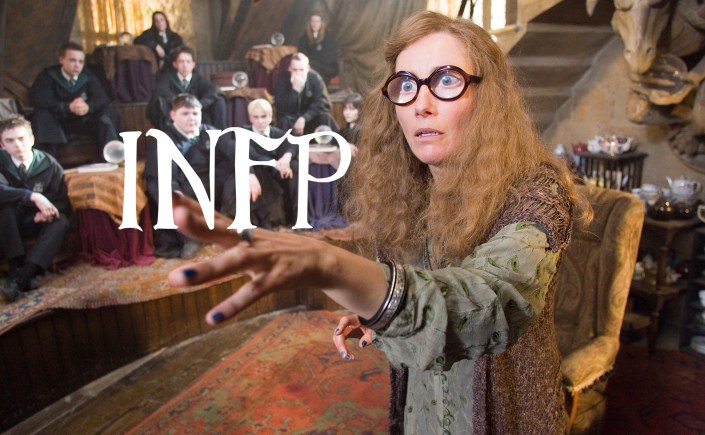
Dominant Introverted Feeling (Fi): Professor Trelawney has a high and highly distorted opinion of herself. She sees and presents herself as a great seer who speaks prophetic words on a daily basis when in reality, she can’t really predict anything correctly while in a conscious state. From the beginning of her lessons, she makes it clear that she disdains most things that can be learned from books. Instead, Professor Trelawney holds her own opinions on her subject as sacrosanct. She marks her students up for agreeing with her, and when she is put on probation, she takes it so badly that she can barely function in her classroom.

Continue reading

Trip – Pokémon: INTP

Guest Post by Andrew, ENTJ

Pokémon Anime Franchise

Dominant Introverted Intuition (Ni): From a young age, Trip wants to train and battle with Pokemon. More specifically, he wants to defeat Alder, the champion of the Unova region, in a Pokemon battle from the time he meets his one-time hero in early childhood. Trip always has an idea of how every battle will end before it even starts, and he uses this ability to judge which battles will help him improve the most (Ni-Te). To Trip, experience and popularity are not necessarily indicators of strength; at the very beginning of his journey, he battles Ash, who has already battled a great deal before, with the full intention of winning––which he does. As Trip himself gets stronger, he starts to believe that he can and will defeat anybody, even regional champions; to prove his point, he chooses a poor strategy in his long-awaited match with Alder, insisting that the result would be the same no matter what. Trip is a largely defensive trainer who lets his opponents attack him first instead of trying to seize the initiative right away in battle.

Continue reading

Stephan – Pokémon: ISTP

Guest Post by Andrew, ENTJ

Pokémon Anime Franchise

Dominant Introverted Thinking (Ti): Although Stephan can be an impatient trainer, he will take a second to think over his situation before he acts. He will quickly and silently analyze each battle he is in, and then unleash his full fury on his opponents. Outside of battle, he will thoroughly examine his weaknesses and those of his Pokémon and will come up with unique ways to counter them. He figures things out alone, with no need for studying or having a mentor. Stephan can be a little too honest when criticizing people, and will sometimes step on their toes by accident. His name has an unusual pronunciation (it’s pronounced ste-FAHN, not STEF-en or Steven), and he always takes a moment to correct the people (i.e. practically everybody) who get his name wrong.

Continue reading

Peter Quill / Star-Lord: ENTP

Guest Post by Emily, INFP

Guardians of the Galaxy

Dominant Extraverted Intuition (Ne): Peter is good at figuring things out, but not making long-term plans, like when he distracted Ronin and grabbed the Orb so the planet wouldn’t be destroyed. Sometimes he spaces out, which allows Gamora to attack him to steal the Orb and get hit in the head at the prison. Before the Guardians go to stop Ronin, he tries to give them hope by giving them a pep talk.

Continue reading

Oliver Queen: ESTP

Guest Post by Kerissa, INFJ

Arrow

Dominant Extroverted Sensing (Se): Oliver works through stress using physical activities, such as working out and sleeping around. He decides to take down those on his father’s list in a very straightforward, literal, and unconventional way. He sometimes takes too much on, such as trying to run a business and fight crime at the same time. He lives in the moment, not thinking about how he’ll continue his mission when he’s older.

Continue reading

ISTJs Put Simply

Guest post by Sylver, ISTP

In my project to make known the good and bad sides of every MBTI type, it’s been suggested that I start with ISTJs. A lot of people, even if they don’t say negative things outright, will ignore or turn up their noses at ISTJs online. Also, as it’s been pointed out, many ISTJs will take and retake the test until they get something other than ISTJ, just because of the stigmas attached to ISTJ-ness.

Part of this has to do with the (mis)conceptions about their type that I will debunk here. Please note, of course, that some of the things I will say may not ring true for every single ISTJ out there. Most are based on knowledge of their functions and personal experience. So do feel free to correct me if I’m wrong; most of this is just stuff that I have observed/experienced when dealing with ISTJs.

ISTJs (USUALLY) are:

  • rooted in the past
  • down to earth
  • planers
  • possessed with incredible follow-through
  • caring
  • dutiful

ISTJs are NOT (usually):

  • stubborn for no reason
  • whiny
  • OCD
  • rule-obsessed
  • socially awkward (any more than other types can be)
  • Or, of course…evil

So without further ado, let me expand on how ISTJs work function-wise. My personal favourite thing about them, for a start, is their rich and vivid memories. I experience life through my Ti and Se (Dom and aux respectively), and though I can often remember things I’ve learned for a long time afterwards I have great difficulty remembering the actual experience because I’m instinctively keyed into the present moment. Always moving on, as it were. As Si-doms, ISTJs often have incredible recall of past events. My Mother, for example, is most likely an ISTJ, and whenever I have trouble recalling an old event I’ll call her up and she’ll readily remind me about what happened.

Si-doms are typically great sources of do’s and don’ts, especially the older ones. Any artist/writer/screenwriter/painter should be able to appreciate the opportunities that come with all those memories and stories. Provided, of course, you’re respectful and the ISTJ in question is willing to chat about things that may or may not bring back intense memories.

The ISTJ’s auxiliary function is, of course, Te. This gives them a natural edge when it comes to managing and coordinating, which I appreciate a lot. When it comes to larger projects ISTJs are pro at making sure they (fairly) divvy up the workload. They also––sorry, Arvid––tend to have an advantage, even over INTJs, when it comes to making sure that no details get overlooked. That’s not to say that INTJs don’t also do everything they can to make sure that their project turns out just the way they visualize it. ISTJs are just more naturally detail-oriented.

Fi is a function that…well, it doesn’t seem to get the right type of love in the MBTI community. By that, I mean that people––especially on tumblr––tend to value/admire Fi for the rebelliousness that ALL Fi users exhibit. /sarcasm/

I really like mature Fi users, don’t get me wrong. They know what they’re feeling and, especially in the case of Fi users who also use Te, will do their best to communicate what they need. That’s a genuinely valuable ability. I always appreciate my Mom’s way of telling me things, for example. I’m not hugely touchy-feely, and she isn’t either, so when she needed alone time she would just say something along the lines of, ‘I’m getting a beer, then I’m going upstairs to read. You need anything?’

That right there is the heart of how an ISTJ cares for their people. Making sure they’re okay by doing what they need to do to help. As an action-oriented person I sure as hell appreciate that.

Finally, there’s that inferior Ne. It bears talking about, as does any other type’s inferior function. We all need to know our weaknesses or we’d all crumble from clay feet, a friend of mine once put it.

An ISTJ’s Ne isn’t going to be all that plain. As with INTJs and Se or ISTPs and Fe, it’ll sorta be in the background, still utilized but typically unnoticed. When it does come to the forefront (so to speak) due to stress, it often trips up the ISTJ in question. They begin to catastrophize and freak out about all the things that could happen; during times like these, they focus almost exclusively on the negative outcomes and need a helping hand/mind to get back on track.

Like any instance where an inferior function crops up in this way, an ISTJ’s inferior Ne can be extremely annoying for both them and for others. Part of the package, though.

Besides, a healthy and mature ISTJ can make the most of their Ne’s idiosyncrasies. My dear friend, for example, will usually be the first person to get on my tuchus about things I’ve been unable to get to (read: procrastinated), yet she’ll also be perfectly willing to tag along with me to get lunch out or go to Half-Price Books together. Provided we’ve got ourselves in order, of course.

Overall, ISTJs can be a little stubborn, but they can also be the wisest, fairest, and most trustworthy people you’ve ever met. They may not be the most popular or ‘romantic’ or ‘trendsetting’ of the MBTI types, yet that’s nothing to be ashamed of. If the entire human race were daredevil ISTPs like me, we wouldn’t have survived till now, I guarantee it.

Joking, of course. I’d like to think that ISTPs do have some modicum of self-control! :P

Delirium: ENFP

Guest Post by Emily, INFP

Sandman, Neil Gaiman / Sam Kieth

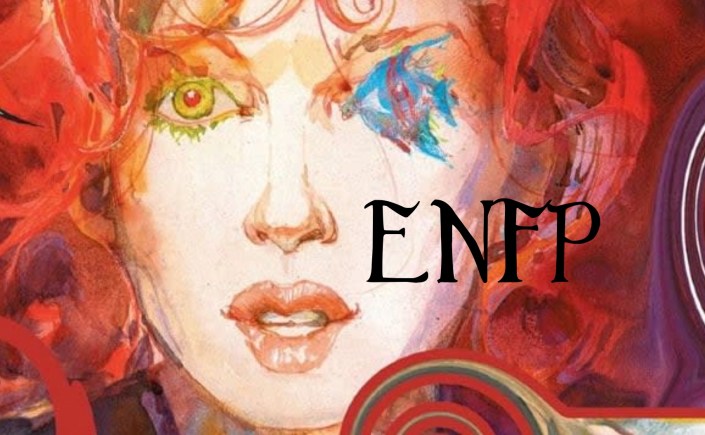
Dominant Extroverted Intuition (Ne): Delirium is scatterbrained and gets distracted in the middle of her own sentences. She uses creativity to escape boredom, like when she makes fish and, eventually, sings a song about one of them. On her quest to bring Destruction back, she keeps looking for people who might have seen him instead of giving up hope. Although she was afraid of Dream in the past, she asks him to help her find Destruction.

Continue reading

William Murdoch: ISTJ

Guest Post by Fanta, INTJ

Murdock Mysteries

Dominant Introverted Sensing (Si): Detective William Murdoch is a very serious, by-the-book, conventional man who is deeply attached to his Catholic religious upbringing. He has a strong sense of duty guiding him when he has to make difficult and personal choices: he chooses justice over stopping the marriage of the woman he loves. He upholds the law to a tee, always tells the truth (even when it leads to freeing a guilty criminal), and minutely follows criminal and scientific procedures. From very early on, Murdoch has developed a keen interest in scientific knowledge, spending so much personal time absorbing all kinds of information through this hobby that he became an expert without consciously wanting to.

Continue reading

Cilan – Pokémon: ENFP

Guest Post by Andrew, ENTJ

Pokémon Anime Franchise

Dominant Extroverted Intuition (Ne): Cilan’s interests are many and varied. He is a Pokemon Connoisseur, a science connoisseur, a fishing connoisseur, a railroad connoisseur, etc. Cilan likes to explore connections between trainers and their Pokemon, and, seemingly at random times, he will put forth his analysis of such relationships (he even interrupts battles to do this). Cilan decides to travel with Ash on the spur of the moment, all because Ash shows him (by example) new possibilities in trainers relating to and working with their Pokemon. He doesn’t count his chickens before they hatch, either in battles or in anything else, and he tends to clash with people who have pre-ordained and/or narrow views on anything.

Continue reading