Dominant Introverted (Si): Orderly and attentive, Violet keeps her space clean and tidy without prompting (SiTe). She is highly detail-oriented, such that she fixates on exact wordings, exact truths/meanings, and exact instructions. She’s also inclined to pay attention to small details of peoples’ appearance, such as Major Bougainvillaea’s eye colour. She thrives on routine (a trait of both Autism and SiTe) and has a strong preference for repetitive activities. In addition to enjoying work as a Doll, Violet regularly dresses in the same clothing (even when not working) and always ties up her hair in the same pattern.
Subscribe to get access
Read more of this content when you subscribe today.
Dominant Introverted Thinking (Ti): Cassian frequently disagrees with the standard logic of others. As a result, he gains a reputation for disobeying orders that don’t make sense to him. Despite consistently working for the rebellion, he doesn’t bother jumping through the “official” hoops that they request of him (such as rules for clearing a ship to leave Yavin). Similarly, he chooses not to kill Jyn’s father because the situation doesn’t make sense to him or his instincts (TiSe). He is naturally analytical, able to evaluate problems and critique them on the fly (TiSe combo) in order to escape danger. Nonetheless, Cassian is a quiet person who keeps most of his logical processes inside.
Subscribe to get access
Read more of this content when you subscribe today.
Dominant Introverted Feeling (Fi): Zuko feels everything intensely, a trait that both makes him a force for good (when he can detach his own moral code from what his father expects of him) and causes him a great deal of suffering. When he forces himself to live by his father’s value system instead of his own, Zuko is plagued by inner dissonance and depression. From a young age, he has a strong sense of ethics and is happiest when he feels aligned with his moral code. His drive to do the right thing pushes him to speak against his father’s military plans, ultimately leading to his banishment from the Fire Nation. As much as he lashes out at people (Mai, his crew, Uncle Iroh), Zuko puts them first when they are in danger. When he makes a mistake, he accepts full responsibility for his actions and does everything in his power to correct the damage he’s caused. As Fire Lord, Zuko puts his life on the line to stand up for the misunderstood people of the Fire Nation colonies. However, when gaslighting and manipulation from his family members cause him to doubt his inner compass, Zuko is wracked with anxiety about whether he’s doing the right thing (to the point of being unable to sleep). When under intense stress, Zuko has the tendency to retreat inward, keeping his struggles to himself despite Mai’s urgings for him to talk openly.
Dominant Introverted Intuition (Ni): Armin is always looking to the future. The most obvious manifestation of this is his perpetual excitement about life beyond the wall. However, even as a civilian child, he accurately predicted the Titan attack moments before it happened. After joining the military, Armin hones his predictive abilities in the service of protecting his friends. He intuitively understands other people, including Titans, and uses this knack to get out of hairy situations more than once. In battle situations, Armin is good at strategically utilising the individual strengths of others, which makes him a great tactician. Armin is at his best when he is sure of his predictive abilities. However, he is tentative and has a hard time making decisions without feeling confident in the outcome.
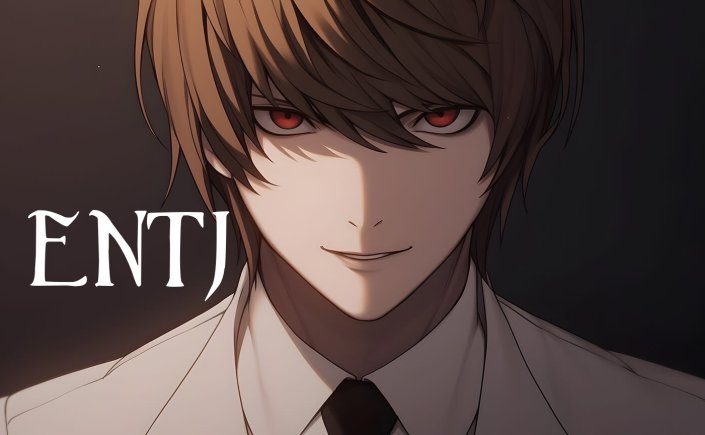
Dominant Extraverted Thinking (Te): Light is an analytical person who values efficiency and order. He has a practical system for everything, from identifying whether someone’s been in his bedroom to ensuring he can still write names if he doesn’t have access to the death note. Light is generally very level-headed in stressful situations, and is really only liable to becoming anxious when things are outside his control. He is incredibly organized and runs a tight schedule in every domain, including academics, extracurriculars, and social life. As a detective, he’s good at taking charge of group plans and readily volunteers to do so (particularly when it will benefit him). Uninterested in theorizing just to theorize, Light prioritizes gaining access to actionable insights and keeping his plan moving forward.
I know––you’re shocked. But before I overcame my fear of scary-sounding terms like “cognitive functions” and “introverted intuition” my only resource for understanding MBTI types were generic descriptions on websites like 16personalities. Because of this, I, like many others, had a sort of MBTI identity crisis. How do you know your type when so many seem to describe aspects of your personality? At various points, I convinced myself I was an INTP (because of my philosophical interests), INFP (because of my career), or ENTP (because of how much I enjoyed expressing my insights).
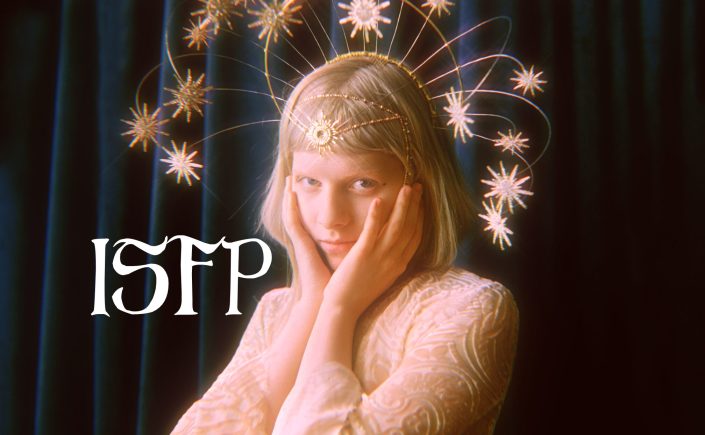
Dominant Introverted Feeling (Fi): Aurora doesn’t care what people think of her. She lives her life in the ways that make her the happiest and encourages other people to do the same. Her music is invested in the idea that people don’t need to try to be what society expects. She’s very open about her inner life and is obsessed with trying to understand and connect with other people better, a theme explored heavily in her discography. She is introverted and often feels drained by the end of a show. Though she loves her fans, she enjoys the creative process of writing music alone in her studio much more than interacting with strangers.
Dominant Extraverted Thinking (Te): Levi is a non-nonsense person who cares about efficiency and reason. In addition to being fairly objective, Levi is comfortable laying out the facts of a situation when others aren’t willing to do so. Rather than becoming reactive in stressful situations, he simply says and does what needs to be said in order to move things forward. This also makes him a good director. When others become emotional, he talks them through situations level-headedly (for example, directing Eren to think carefully about his impulse to turn Titan during the boy’s first outing as a Scout). He is so dedicated to accepting facts that he gets annoyed when Eren doesn’t tell Armin the whole story about why Armin was saved instead of Erwin. Levi is adept at redirecting conversations in a productive direction, a skill he uses regularly to keep his subordinates on task.
Dominant Extraverted Sensing (Se): Rhaenyra is very attuned to the present moment and is quick to adapt to new events. She doesn’t usually need much time to process situations and people, and can make snap decisions when required. She readily accepts what is happening now, even when it’s awful (i.e. a miscarriage). However, she wants physical evidence before she’s ready to acknowledge her second child’s death. She is very driven by bodily pleasure and frequently allows it to cloud her judgment. Her sexual relationships often get her into trouble.
Subscribe to get access
Read more of this content when you subscribe today.
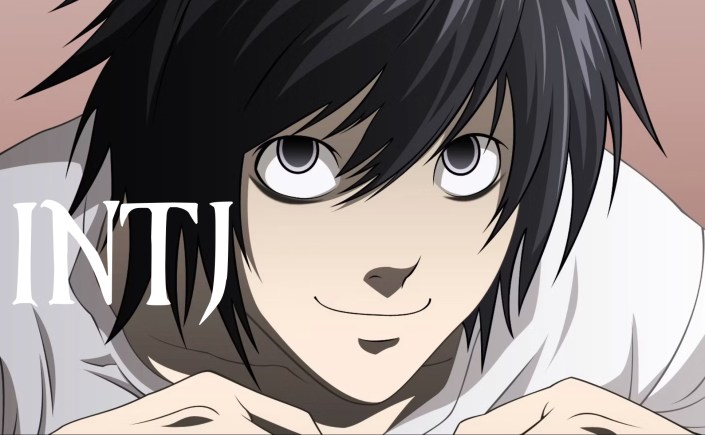
Dominant Introverted Intuition (Ni): As the number one detective in the world, L uses his Introverted Intuition first and foremost to solve a case, intuitively coming to a conclusion near the outset and afterwards spending time and effort to prove his impressively accurate hunches. In a ploy to determine Kira’s whereabouts, a ploy L is prepared to use worldwide, one zone at a time. L succeeds on his first try. When L states that he is 5% sure that Light is the real Kira, he is actually 100% sure (Ohba, Tsugumi (2008). Death Note 13: How to Read) but he lacks the proof to convince others. In spite of proof to the contrary, L continues to suspect Light when everyone else has moved on. L has a single-minded determination to catch Kira, putting other cases aside and going to extreme lengths to catch him, to the point that he has an entire skyscraper built to serve this single case. In general, his lifestyle is built around solving cases, and his surroundings are often Spartan despite his affluence. He tends to ignore his appearance, as well as the general perception people have of him, but he typically has an explanation for his odd behaviour (he claims his habit of crouching increases his mental faculties, and he continues in that posture even though Japanese culture highly values proper posture).
I have always been a very self-aware individual. I know my strengths, weaknesses, emotions and thought processes extremely well, and I’m comfortable with who I am. I already KNOW that I’m a walking paradox. I’m a dreamer and yet I’m practical, I’m creative yet analytical, I love art and excel creatively, but I’m also a maths genius. I’m social yet shy, hard-working but a procrastinator, and organized but messy. There has never been a doubt that I am very much an INFP; however, these little contradictions between me and a stereotypical INFP used to concern me. This was before I realized that MBTI is about the way in which we think, not our personalities. Every person is going to have contradictions and conflicting qualities or tendencies, and that’s okay! That’s what makes us unique and human!
That being said, here are five ways in which I do NOT fit the INFP stereotype (in contrast to the many, many ways in which I do).
Identifying the MBTI type of someone with a mental illness, regardless of the kind, can be difficult. It is doubly so when the individual in question has a personality disorder.
A Basic Overview
Note: The personality disorder labels I will be using come from the DSM-5, the diagnostic manual currently used by American psychologists. I realize that other countries tend to use versions of the ICD-10, the World Health Organization’s diagnostic manual, more heavily than the United States does at present. I have tried to include alternate names where I think it is needed for clarity.
For those who are not familiar with personality disorders, there are 10 specific disorders (although the number has varied over time and will probably continue to be revised). They can be organized into three groups—personality disorders that result in odd behaviour, those that result in dramatic or erratic behaviour, and those that result in anxious behaviour. Occasionally someone may be diagnosed with an unclassified personality disorder or a mixture of personality disorders. Unlike most mental illnesses, personality disorders are consistent over time and in a variety of settings. People with the disorders do not experience them as illnesses—the disorders are simply part of the way they function. A person with this category of mental illness generally sees their behaviour as normal and does not want therapy unless they end up with a comorbid illness like depression (in some cases, brought on by others’ negative reactions to their behaviour).
As a result, most people with personality disorders do not usually get diagnosed, much less treated. Learning about the disorders can be a good idea—particularly if you know a “difficult” person and want to respond more effectively to their behaviour. You can’t diagnose them officially, but you can certainly use your research to decide what your strategy should be when you interact with them.













 The Book Addict's Guide to MBTI: