Moana: ISFP

Guest Post by Debaparna Das, INFJ

Moana (2016)


Dominant Introverted Feeling (Fi):
One of Moana’s strongest character traits is her compassion. It’s implied that that’s why the Ocean chose to trust her while she was still a small child. She is fiercely loving and protective of her parents, her pets (although they don’t always share her taste for adventure), and her tribe. She finds it impossible to disregard her own emotional needs merely to comply with communal conventions. As a result, she struggles because her desire clashes with her duties towards her parents and her island. She prefers to follow her own ideas and ethics, resenting being put down over patriarchal notions (see her reaction to Maui questioning her quest). Automatic empathy with others’ feelings isn’t her forte (again, see her reaction to Maui’s brooding). In the same vein, she doesn’t actively seek out anyone’s help in dealing with her issues. It’s up to her grandmother, Tala, to understand her condition and advise and comfort her. Although she loves the ocean dearly, she decides to sail away mainly in the hope of saving her tribe from a slow death due to environmental degradation and starvation.

Continue reading

Leonard Hofstadter: ISFJ

Guest Post by Lucas, INTJ

The Big Bang Theory

Dominant Introverted Sensing (Si): Leonard can either get very nostalgic about his past experiences (such as making quality comparisons about the present environment with the past regarding his hobbies) or be extremely disgusted by them (as his mother treatment towards him). In both cases, however, they dictate his decisions: although he is less whiny than Sheldon about changes, he still feels better in a same pace middle-class life and is unwilling to change that. Because his mother neglected his feelings, he uses that memory in many humorous situations in the present, albeit becoming sensitive in the process.

Continue reading

Stilgar: ESTJ

Guest Post by Andrew, ENTJ

Dune, Frank Herbert


Dominant Extraverted Thinking (Te):
Everything about Stilgar screams “leader.” He is most comfortable in positions of authority over and responsibility for others. Stilgar has efficiency as his first priority at all times; this is instrumental in his acceptance of Paul’s reforms of Fremen society (because why would anyone in their right mind exterminate the strongest Fremen soldiers before the big battle for Arrakis?). Stilgar is a direct communicator with a sharp tongue; he minces no words in saying what needs to be said.


Auxiliary Introverted Sensing (Si):
Stilgar has every respect for Fremen culture and traditions. Even though he is open to changing the rules when the objective reality demands it, he will not initiate these changes, nor will he attempt to make them single-handedly. Most notably, he will not bend the rules without a practical reason for doing so. Stilgar knows a great deal about the Fremen mythology concerning Bene Gesserit “witches” and the Mahdi (the long-awaited prophet for the Fremen), which leads him to adopt Paul and Jessica into his tribe.

Tertiary Extraverted Intuition (Ne):  Stilgar can appreciate the symbolism of Paul’s Fremen name (Muad’Dib). He can anticipate which new developments are on the horizon at any given time, and he is open to some changes as the situation warrants. In particular, Stilgar believes in Paul’s mission to terraform Arrakis into a more hospitable planet.


Inferior Introverted Feeling (Fi):
Stilgar usually puts any emotions, whether his own or anyone else’s, aside when making decisions. While he internally acknowledges his emotions, he just doesn’t consider them important enough to guide him on how to lead his tribe. Instead of having his own moral code, he has internalised the moral code of the Fremen, and follows it with all necessary rigor.

Author’s Note:

Jay Walker: ISTP

Guest Post by Lewis Sanderson, INFJ

Ninjago: Masters of Spinjitzu

Dominant Introverted Thinking (Ti): His logic comes from what he thinks inside, and the decisions and facts he comes up with are usually the kind that look good on paper but fail to work in practice. Jay is not naïve either, and is quite sceptical of Nadakhan’s motives when he first appears. He knows not to trust people, as a rule, and loves to find out that he was right. Jay doesn’t let other people tell him what to think, and has a very set mind that is always buzzing with ideas. Despite the fact that he is almost always talking, he rarely voices his actual thoughts and prefers to break apart and mock things that others have said.

Continue reading

Regina George: ESTJ

Joint post by Arvid Walton and guest writer, Morgan, INTP

Mean Girls

Dominant Extraverted Thinking (Te):  Regina is a born executive who always likes to be in charge. She enjoys order, loves making up rules, and telling people what to do (“On Wednesdays, we wear pink” fulfils each of these interests for her). A large proportion of her sentences are direct orders or declarations of fact, indicating that she’s action-oriented and practical in her communication style. She even orders her own mom around. She can be rather blunt in her speech and isn’t afraid to hurt others’ feelings in the process. She also has a dislike of things that she considers illogical (e.g., trying to make “fetch” happen).

Auxiliary Introverted Sensing (Si): Regina likes structure and routine more than the average person. In addition to following the same daily and weekly routines, she has her friends do the same dance to the same song every year. Many of the rules she creates are also designed to generate and maintain a group tradition (centred around herself, of course). She uses these traditions to establish her superiority over others and ultimately “manage” her social world.

Tertiary Extraverted Intuition (Ne): This function is fairly undeveloped in Regina, though she does use it occasionally. For example, when she’s trying to lose weight, she tries everything she can think of, becoming so willing to try new things that she falls for Cady’s weight-gain ruse because she isn’t checking the facts for herself. She is also fascinated by Cady because of the difference in their experience.

Inferior Introverted Feeling (Fi): This is another function that Regina hasn’t developed very well. She shows little to no concern for how other people feel (unless it’s how they feel about her). She is self-absorbed and unkind, actively putting others down in order to build herself up.

Alastor “Mad-Eye” Moody: ISTJ

Guest Post by Andrew, ENTJ

Harry Potter, J.K. Rowling

Dominant Introverted Sensing (Si): Above all else, Moody does not like to take chances. He would rather take a long time doing something to make sure that he is successful than take a shortcut about which he is the least bit unsure (e.g. taking Harry to the headquarters of the Order of the Phoenix). Moody uses a magic eye which allows him to be completely aware of his surroundings: it can move around in his head freely, and see through anything at its owner’s will. Moody uses each person’s past behaviour as an indicator of what he or she will do in the future, and he neither forgets nor fully forgives past transgressions. Moody enjoys comparing a group photograph of the original Order of the Phoenix with the membership of the new Order, and going over what happened to each member who didn’t make it.

Continue reading

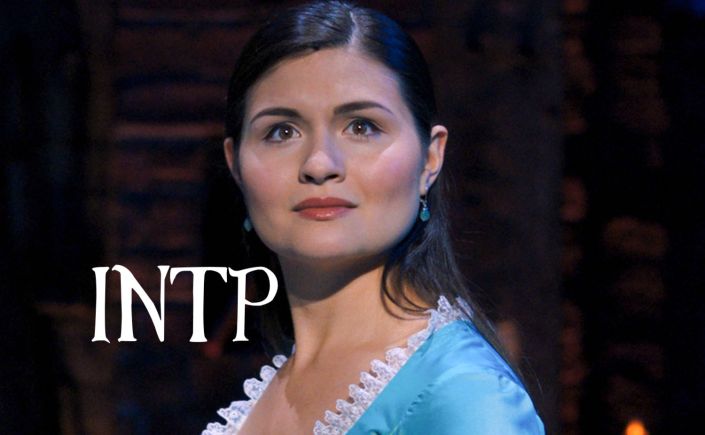
Eliza Hamilton: INTP

Guest Post by Alex, ENFP

Hamilton

Dominant Introverted Thinking (Ti): Throughout the play, Eliza shows a clear preference for taking her time to think about things rather than leaping into the emotions of the situation. When falling in love with Hamilton, a much more energetic and spontaneous Se-dom, she feels “helpless,” and out of control, all though maybe in a good way. A lot of their courtship actually happens through letters, although “Helpless” focuses mostly on their in-person interactions. Written correspondence leaves more time for reaction and processing things, so it makes sense that this is where she was most comfortable. Later, in “Burn,” she says, “I’m re-reading the letters you wrote me/ I’m searching and scanning for answers/ In every line/ For some kind of sign.” Although this is at least partially retreating into Si, she’s also dealing with her intense emotional reaction through analysis, even though logically it probably won’t reveal anything about her husband’s motivations. Historically, she also remained very involved in politics after Alexander Hamilton’s death, co-founding the Orphan Asylum Society, organizing all of Alexander’s writings, raising funds for the Washington Monument, and defending Alexander to his critics, including, notably, President James Monroe. In “Who Lives, Who Dies, Who Tells Your Story,” she says before listing her accomplishments after Alexander’s death, “I stop wasting time on tears.” She prefers remaining emotionally detached, analyzing and working and getting things done, she just has gone through some very emotionally devastating experiences.

Continue reading

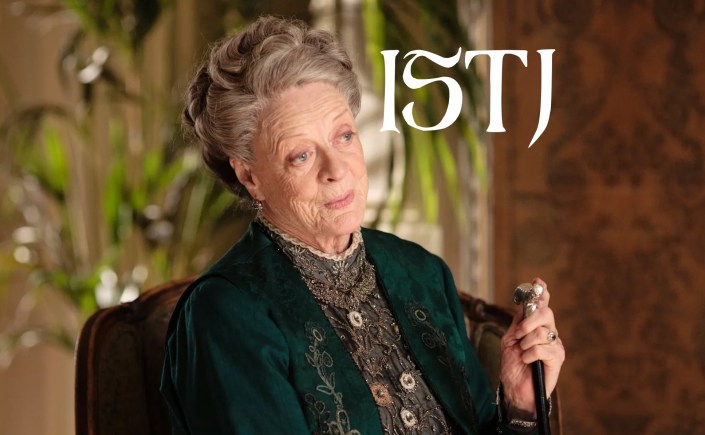
Violet Crawley: ISTJ

Guest Post by Alberto Belota, IxTJ

Downton Abbey

Dominant Introverted Sensing (Si): The Dowager Countess is uncomfortable with change and prefers to live by tradition. Her primary motivation in many episodes of Downton is the preservation of traditional, pre-WWI value systems, as well as social systems. She also has a difficult time seeing why other people may view things differently (and still be considered reasonable) when faced with change. Violet uses the past as a source of emotional security and validation, even when it’s perhaps not the most efficient or cost-effective way of life (such as opposing the installation of electricity in the Dower House).

Continue reading

Alex Drake – Ashes to Ashes: ESTJ

Guest Post by Debaparna Das, INFJ

Ashes to Ashes

Dominant Extraverted Thinking (Te): Alex wants to be in control over her environment, her body, and her fate, all the time. She is thoroughly methodical and goal-oriented, setting clear priorities, drawing up plans, and following precise steps to achieve those goals. If there’s something she’s put her mind to, nothing – except getting bound, gagged, and thrown into a freezer––can stop her from doing it. (She revives a woman from clinical death using CPR and sheer determination.) She gets impatient with the team’s incompetence and problematic attitudes and can be quite ruthless at times. She doesn’t believe in anything without hard evidence to prove it, and is a tireless worker, sometimes going without the recreational breaks that the rest of the team can’t give up on. She asserts her authority by adopting a blunt, somewhat aggressive persona, sometimes shocking the team with her behaviour. However, she can quickly change her attitude when needed, using her training in psychology and criminal behaviour to soothe, intimidate, lead, and manipulate people. As a result, by series 3, the team is following her instructions as promptly as DCI Gene Hunt’s, to the point that Gene feels threatened at times.

Continue reading

Sirius Black: ESFP

Guest Post by Andrew, ENTJ

Harry Potter, J.K. Rowling

Dominant Extraverted Sensing (Se): Sirius always craves excitement. He got into a great deal of trouble in school because he took lots of risks for the sake of having fun, and often got himself caught. Sirius almost never thinks before acting, and his reactions to bad situations give even Harry (who has an impulsive streak himself) pause about telling him too much. Sirius is a visual person who decorated his bedroom with pinup pictures as a teenager and who treats Harry like his deceased father (Sirius’ best friend) based primarily on his appearance. After Voldemort’s return, Sirius is stuck inside his mother’s house, which irks him like nothing else. His eagerness to be out there doing something, especially when Harry and his friends are in danger, leads to him being killed in action, and according to Albus Dumbledore, that is his ideal way to die.

Personality Tests Aren’t Very Accurate––Use This Alternative

Guest Post by Kyle Farris, INTJ

I know––you’re shocked. But before I overcame my fear of scary-sounding terms like “cognitive functions” and “introverted intuition” my only resource for understanding MBTI types were generic descriptions on websites like 16personalities. Because of this, I, like many others, had a sort of MBTI identity crisis. How do you know your type when so many seem to describe aspects of your personality? At various points, I convinced myself I was an INTP (because of my philosophical interests), INFP (because of my career), or ENTP (because of how much I enjoyed expressing my insights).

Continue reading