
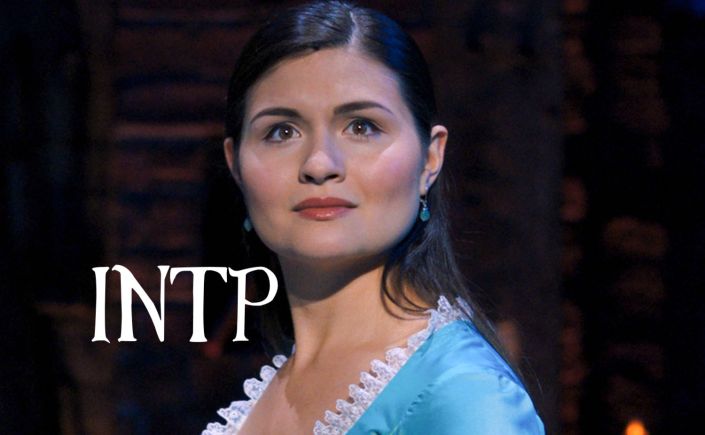
Guest Post by Alex, ENFP
Hamilton
Dominant Introverted Thinking (Ti): Throughout the play, Eliza shows a clear preference for taking her time to think about things rather than leaping into the emotions of the situation. When falling in love with Hamilton, a much more energetic and spontaneous Se-dom, she feels “helpless,” and out of control, all though maybe in a good way. A lot of their courtship actually happens through letters, although “Helpless” focuses mostly on their in-person interactions. Written correspondence leaves more time for reaction and processing things, so it makes sense that this is where she was most comfortable. Later, in “Burn,” she says, “I’m re-reading the letters you wrote me/ I’m searching and scanning for answers/ In every line/ For some kind of sign.” Although this is at least partially retreating into Si, she’s also dealing with her intense emotional reaction through analysis, even though logically it probably won’t reveal anything about her husband’s motivations. Historically, she also remained very involved in politics after Alexander Hamilton’s death, co-founding the Orphan Asylum Society, organizing all of Alexander’s writings, raising funds for the Washington Monument, and defending Alexander to his critics, including, notably, President James Monroe. In “Who Lives, Who Dies, Who Tells Your Story,” she says before listing her accomplishments after Alexander’s death, “I stop wasting time on tears.” She prefers remaining emotionally detached, analyzing and working and getting things done, she just has gone through some very emotionally devastating experiences.
Auxiliary Extroverted Intuition (Ne): Eliza is a lot more adaptive to new ideas than some people give her credit for. For one, she married Alexander Hamilton, an immigrant born out of wedlock in the Caribbean who was an aide-de-camp to General Washington, hardly an expected marriage for the daughter of one of the most influential men in New York. In her later years, she was a fierce abolitionist, despite having grown up in a prominent slave-owning family surrounded by a normalized version of slavery. She was also very independent and fiery, especially for a woman of the time, described by one of Alexander Hamilton’s fellow aides-de-camp, James McHenry as having “a strong character with its depth and warmth, whether of feeling or temper controlled, but glowing underneath, bursting through at times in some emphatic expression.” Ne-users are often well-controlled at times but bursting with energy when a topic they’re passionate about is mentioned, a description that seems to match Eliza fairly well. In the play, this is shown in her excitement about “new ideas in the air” and her fierceness in the face of difficulty.
Tertiary Introverted Sensing (Si): Eliza has a fairly well-developed Si, so it’s pretty easy to spot in several situations. Historically, she grew up around religion and then for the rest of her life was extremely devoted to her religious beliefs. In the play, her Si is most notable in her lyrics of “Look at where you are/ Look at where you started/ The fact that you’re alive is a miracle/ Just stay alive, that would be enough,” and the aforementioned “I’m re-reading the letters you wrote me/ I’m searching and scanning for answers/ In every line/ For some kind of sign.” Both of these show an eye to the past, a desire inside her to learn from past events. However, her Si is a lower function, and she doesn’t always adhere to her old beliefs. She became an abolitionist, at least in theory if not totally in practice, and married a poor immigrant.
Inferior Extroverted Feeling (Fe): Eliza, despite popular belief, doesn’t have a great understanding of her own feelings. In “Burn,” her hands-down most emotional song, she talks about what Angelica said, what Alexander did, what he appears to be to her now, and what historians will get to know. Not once in the song does she say “I feel betrayed” or “I’m upset” or any statement of her own emotions. She instead focuses on other people’s moral standings and how the public will view her. Another instance that particularly emphasizes Fe over Fi is the fact that Angelica is convinced that Eliza would give up Hamilton if Angelica had just said she loved him, despite Eliza also being just as in love with him.
Author’s Note: On the internet, Eliza is almost exclusively typed as an INFP which just mind-boggles me. As I pointed out in the Ti and Fe sections, she’s really not very emotional in the scheme of things, she just reacted emotionally (although to be honest not as emotionally as people seem to think) to her husband CHEATING ON HER. She’s also far more politically minded than people give her credit for. I’ve also seen her typed as an INFJ, but I don’t find her using Ni-Fe a very compelling argument considering that she doesn’t seem to realize at least how deeply attracted Angelica is to Alexander (if she even realizes at all). I also considered ISTP, but she clearly has Si present in her hierarchy and a lot of the behavior I initially saw as Se could also be Ne.
Also, this post is typed mostly based on Lin-Manuel Miranda’s depiction of Eliza because it’s the version I’m more comfortable with.
 The Book Addict's Guide to MBTI: