
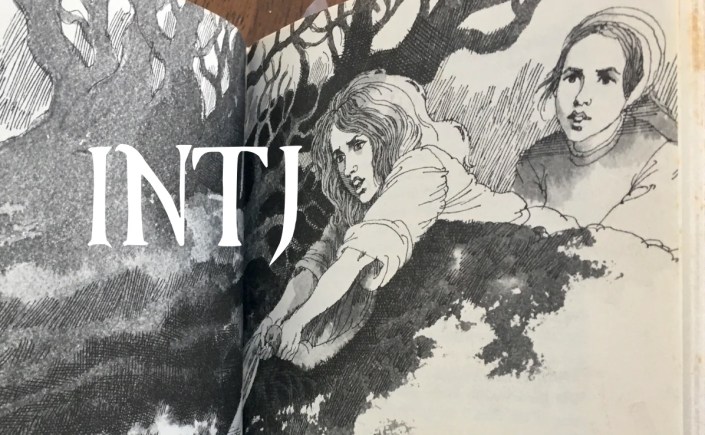
Guest Post by E.J., INTJ
The Perilous Gard, Elizabeth Marie Pope
Dominant Introverted Intuition (Ni): As a young woman in Tudor England, Kate’s ability to shape her future is somewhat limited. Her role as a royal maid of honour means that she has to follow orders, regardless of her personal opinions. Kate does, however, have a strong future orientation. To prevent Christopher Herron from becoming unhealthily detached from reality during their imprisonment by the Fairy Folk, Kate forces him to plan ways to rebuild the deteriorating manor he has been longing to buy. She also refuses the Lady’s initial reward offer because she recognizes that its ultimate effects would be damaging. Kate is unusually good at putting together big-picture ideas. While Cecily’s relatives have accepted Cecily’s supposed death, only Kate—a newcomer to the area—is able to piece together what actually happened.
Auxiliary Extroverted Thinking (Te): Although Kate’s ability to plan for the future is limited, her ability to comment on the present is not. Kate holds strong opinions, and she usually does not mince her words. Her father encouraged this quality in her, allowing them to have an unusually candid relationship. Kate struggles to bond emotionally with those who cannot accept her directness, but she can be diplomatic when her situation requires it. Unlike most of the women she knows, Kate is extremely practical and logical. She rejects older scholarly traditions for modern handwriting and humanistic scholarship. She easily grows impatient with people who are overly emotional or of a romantic temperament. Kate’s stubbornness can be a problem at times—it is responsible for her capture—but it also is why she is able to keep her wits about her and, eventually, free Christopher.
Tertiary Introverted Feeling (Fi): Kate is difficult to influence. While her mother’s, nurse’s, and sister’s hurtful opinions of her temperament damage her relationships with them, she does not change to suit their preferences. Christopher’s initial condescending attitude toward Kate makes her feel foolish at times, but she continues to interact with him in largely the same way. Kate is extremely loyal to a few people—particularly her father. His respect for her intelligence provides her with the emotional support she needs to deal with her mother’s criticisms, and her respect for him gives him an unusual amount of influence over her. Kate initially tries to help Christopher because she is annoyed by the illogic of his depressed behaviour, but as he grows to interact with her more like her father does, Kate becomes attached to him emotionally. She willingly throws away advancement in a world she is better suited for in order to save his life. Kate’s ironclad moral code is another reason that she acts as she does. No matter how pleasant a different lifestyle would be, she is unwilling to reject her own beliefs or harm other people to achieve personal happiness.
Inferior Extroverted Sensing (Se): Kate’s Se is relatively weak at the beginning of the story. Although she is not actually an ugly girl, her stiff posture and resulting clumsiness often lead others to consider her unattractive. Kate’s awkwardness and discomfort with her physical surroundings contribute to her lack of confidence in herself (being confident of her opinions is, to Kate, an entirely different matter). Living a simpler lifestyle in plainer clothing helps Kate in this area, especially with the physical training she receives from Gwenhyfara. As Kate’s Se function matures, she becomes a more well-rounded person and is able to leave some of her older insecurities behind.
Author’s Note: A lot of fictional portrayals of INTJs are largely based on stereotypes, and accurate portrayals of female INTJs, in particular, are rare. Although little biographical information on the book’s author, Elizabeth Marie Pope, is available, the accuracy of how she portrayed Kate suggests that she may have been a female INTJ herself. Kate’s character was the first female book character that I ever really identified with.
 The Book Addict's Guide to MBTI: