
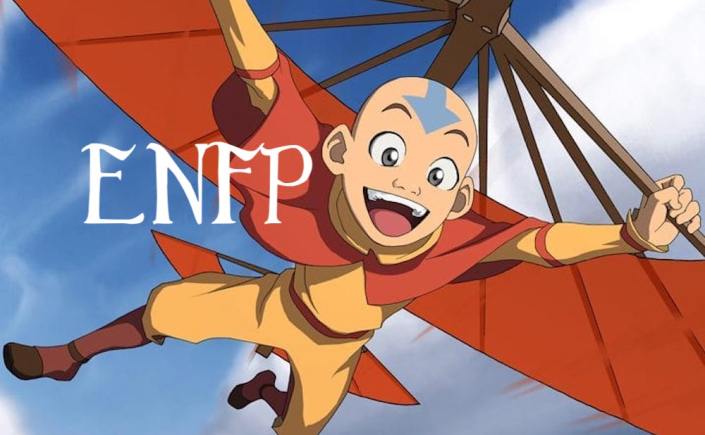
Official typing by Arvid Walton
Avatar: The Last Airbender
Dominant Extraverted Intuition (Ne): At his core, Aang is an exploratory person who values variety in his daily life. He actively pursues new experiences and friendships that are far more diverse than those of most other people in his world. He has friends from every nation, age group, and social circle, and manages to maintain contact with most of them. He is an open-minded person who likes to consider all sides of a story before judging people, even his enemies. This makes him good at resolving conflicts between complex cultures and people. It also means that he gives Zuko much more of a chance to be good than others. His desire to consider all possibilities often makes him indecisive, particularly when it comes to decisions that he feels immense responsibility over (such as whether to kill a close friend in the comics). Aang often struggles to stay focused on one task at a time and prefers to seek newness over routine, a tendency that causes him to diverge frequently from his long-term objectives (such as defeating Fire Lord Ozai). He is a chronic procrastinator but grows into his responsibilities over time. Aang is as creative in his approach to problem-solving as he is at having fun. He invents new airbending moves and finds alternative solutions that others don’t consider (even when it involves making up a story on the spot to convince two warring tribes to stop fighting).
Auxiliary Introverted Feeling (Fi): Aang is a sensitive soul who cares deeply about other people and the environment. He’s prone to internalizing his feelings and tends to seek escape/time alone when he’s struggling. For instance, when hurt by the monks’ desire to separate him from his mentor, he leaves the monks. He sometimes leaves conversations/rooms when hurt by other people (such as when a fan club misappropriated sacred aspects of his culture in the comics). Aang blames himself when things go wrong (both in his personal life and around the world). He also needs a lot of encouragement (mainly from Katara) to speak openly about his struggles. Often, his emotions overwhelm him, and he relies on her to help him calm down and process his feelings. During these periods of overwhelm, Aang experiences nightmares and self-doubt. Even as a child, Aang has a strong sense of right and wrong and has specific moral standards that he lives by (like being vegetarian and unwilling to kill). When pressured to break this moral code, he struggles internally and lashes out at others.
Tertiary Extraverted Thinking (Te): Aang communicates directly. Rarely dancing around a topic (besides his own feelings), he prefers to get right to the point. He asks direct questions and is good at moderating group conversations. He is active in his role as a peacemaker both in his interpersonal life and on a global scale. He’s well known for his preference for talking things out over fighting and actively presents this as an option whenever anyone tries to fight him. For a long time, Aang struggles to break his goals down into concrete steps that he can work toward but gets better at it as he matures.
Inferior Introverted Sensing (Si): Though he adapts well to being thrust forward a hundred years, Aang misses his old life. He can sometimes take a long time to accept major changes, including the revelation that he’s the Avatar, the responsibility to end Fire Nation supremacy, and the industrialization of once-natural spaces. The last of his kind, he feels a strong responsibility to preserve and cultivate the traditions and culture of his people. As a parent, he pushes this responsibility onto his airbending son, Tenzin, taking him on many airbender excursions while leaving his other children feeling left out at home.
Author’s Note: This commentary disregards the live-action productions of Avatar: the Last Airbender, using as its source material the original animated series along with the comics and other official Avatar Studios productions.
 The Book Addict's Guide to MBTI: