
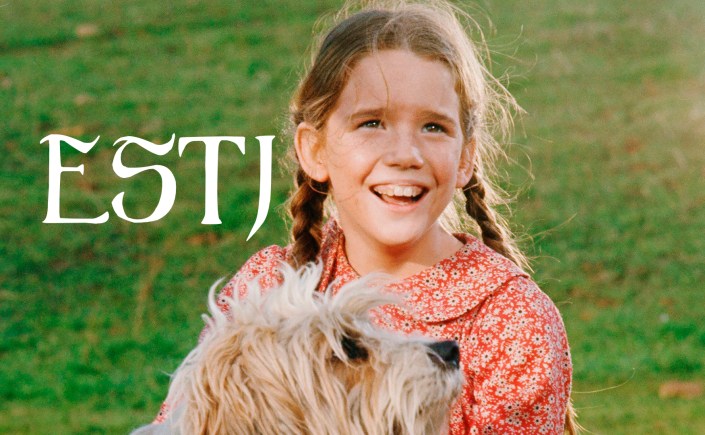
Guest Post by Jessica Prescott, INFJ
Little House on The Prairie, Laura Ingalls Wilder
Dominant Extroverted Thinking (Te): Throughout the nine books in the Little House series, Laura Ingalls is distinguished above all by two main character traits: blunt speech and quick action. More than anyone else in her family, she believes in saying what needs to be said and doing what needs to be done. Laura sees little point in sugarcoating the truth to save others’ feelings. For example, at the beginning of These Happy Golden Years, she tells Almanzo Wilder point-blank that she’s not romantically interested in him and that his driving her home every week won’t make any difference in how she feels. Even as a young girl, Laura can pinpoint the most direct solution to any problem and organize others to help her implement that solution. In Banks of Plum Creek when Pa and Ma are gone and a blizzard comes up unexpectedly, Laura is the one to realize that there’s no firewood in the house and the one who rounds up her sisters to go and collect a supply from the woodpile outside (This, despite the fact that Ma had specifically told the girls to “stay inside if it storms”; unlike Mary, who insisted on following their parents’ rules, Laura can make her own rules to alleviate a potentially dangerous situation.) After a slightly rocky start, she can successfully discipline students older than herself when teaching her first school as a fifteen-year-old. Finally, she has a strong work ethic and sets high expectations for both herself and others.
Auxiliary Introverted Sensing (Si): There’s a reason why Pa chooses Laura to be Mary’s “eyes” after the latter goes blind due to scarlet fever: Laura is inherently observant, detail-oriented—and responsible. She slips easily into a pattern of describing everything she sees for her sister’s benefit, even down to the smallest details; and she often employs comparisons and similes in those descriptions to flesh them out (something that comes naturally to Si/Ne users). Although she was definitely a rebel and a tomboy as a young girl, Laura becomes more and more aware of and concerned with, social norms and rules as she grows up. In general, she’s quite comfortable with the idea of following tradition: When her Si-dom mother, Caroline, states that Laura must prepare for a teaching career to carry on the family legacy, Laura can instantly understand and respect her decision; even though she herself doesn’t want to be a schoolteacher, it seems natural to her that Ma should expect her to do what the women of their family have always done.
Tertiary Extraverted Intuition (Ne): For such a practical, hardworking person, Laura has a surprisingly strong and playful imagination. When she’s not too busy, she enjoys experimenting with ideas and concepts—something which delights her father but tends to annoy Ma and Mary. For example, when Laura describes Big Jerry from Silver Lake as “riding into the sunset,” Mary points out, aggrieved, that he’s actually just “riding along the ground, like everybody else.” Like her father, Laura loves travelling, especially to new, wild, unsettled places, and she responds easily to the romanticism of the Western lifestyle.
Inferior Introverted Feeling (Fi): Laura is incredibly devoted to her family, but prefers to show it through her actions, rather than through words or other overt expressions of affection. Although she’ll never tell them outright, “I love you,” she makes enormous sacrifices of her time and effort to help take care of her parents and sisters, especially Mary—to the point of becoming a schoolteacher, even though she loathes the job, to earn the money needed to put Mary through college. In general, Laura is extremely self-contained and tends to bottle up her feelings and emotions; although, occasionally, those emotions get the better of her and explode in an outburst of temper. Laura has a strong, black-and-white moral code: as far as she’s concerned—if something is wrong, it’s WRONG. There’s no middle ground.
Author’s Note: Laura is usually typed as an Si-dom, either ISTJ or ISFJ. While I agree that she’s a high-Si user, I don’t think it can be her dominant function, for two main reasons: First of all, even as a small child, Laura was never one to insist on familiar surroundings—on the contrary, she loved travelling around and exploring new places. If she’d had her way, in fact, her family would have continued moving farther West and following the railroad for the rest of their lives, never settling down in any one place. Second, I don’t see anything to indicate that Ne was her weakest function; actually, she was relatively comfortable with using her imagination and wasn’t that bad at adapting to new situations. If you compare Laura to her mother, Caroline, you can quickly begin to distinguish which of them is Si-dom and which one isn’t.
The ISFJ typing is probably based on her sacrifices for her family, something stereotypically associated with Fe-users; but Fi-users can be equally capable of family devotion and sacrificial love. I don’t think somebody as bluntly outspoken and emotionally reserved as Laura Ingalls could really be Fe/Ti.
Finally, I believe she’s often typed as an introvert on account of her shyness and her lack of people skills; but you can be a cognitive extrovert and still struggle in dealing with people . . . especially if you’re a thinking type who doesn’t connect easily with others’ emotions.
 The Book Addict's Guide to MBTI: